
2019
Reference book
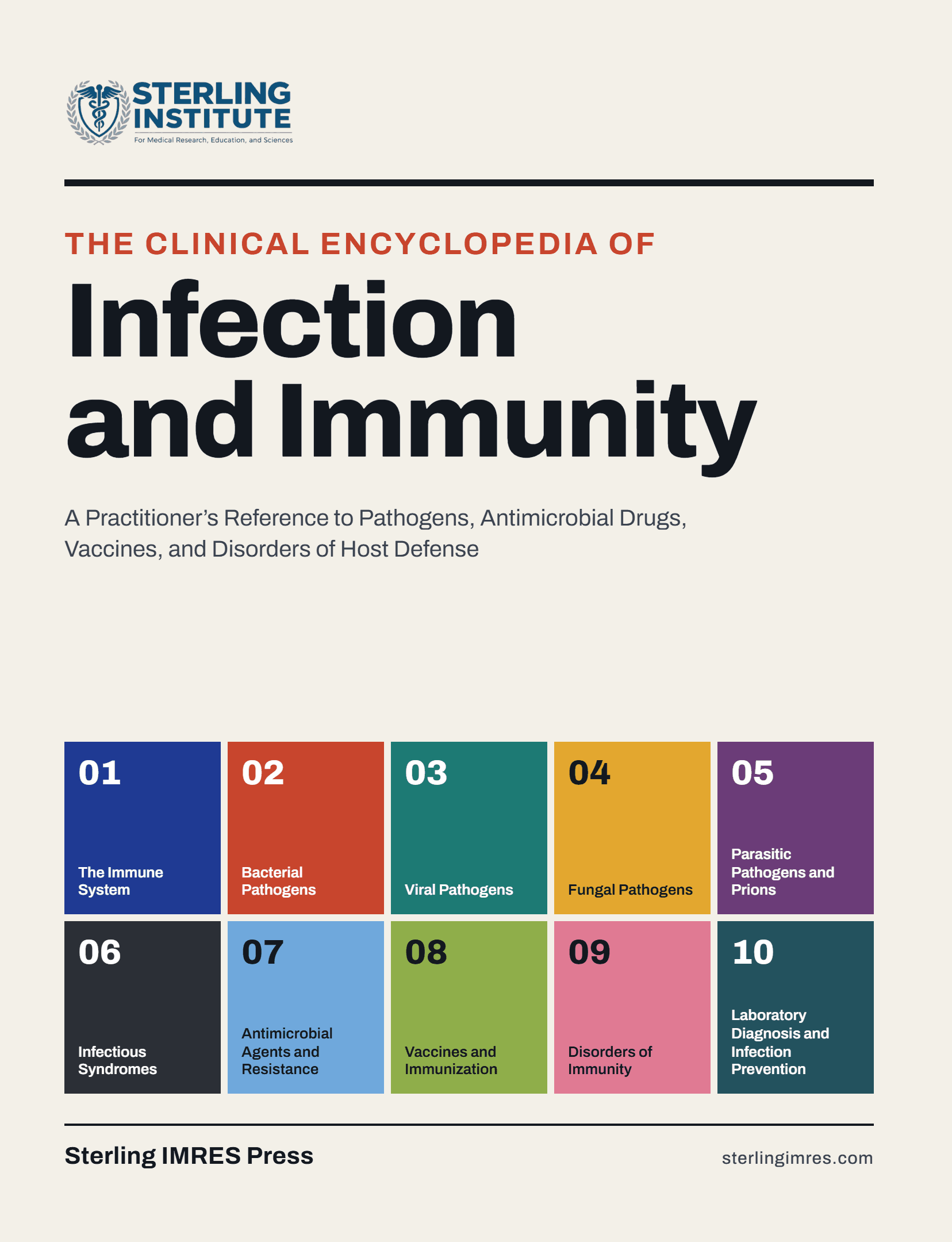
The Clinical Encyclopedia of Infection and Immunity
A Practitioner's Reference to Pathogens, Antimicrobial Drugs, Vaccines, and Disorders of Host Defense
Sterling IMRES Press · 2026
About this book
A patient on chemotherapy develops a fever. There is no pus, no focal sign, and very little time. Making sense of it takes microbiology, immunology, and clinical medicine at once, yet those subjects are usually taught and published apart. Understanding infection requires more than naming a pathogen. You need to know how it causes disease, how the immune system responds or fails, which diagnostic findings matter, and how resistance, host factors, and prevention shape clinical decisions. When those answers sit in separate textbooks, finding them at the point of decision is slow. The Clinical Encyclopedia of Infection and Immunity brings these subjects together in 185 self-contained entries across ten parts. Organized for lookup rather than cover-to-cover reading, it helps you move from a presenting problem to the relevant pathogen, immune mechanism, diagnostic approach, and management principles. What you will find inside: Host defense and its disorders: innate and adaptive immunity, complement, antibodies, lymphocytes, and cytokines, alongside antibody, complement, and phagocyte defects, hypersensitivity, autoimmunity, and transplant-related infection risk. Bacterial, viral, fungal, and parasitic pathogens: virulence mechanisms, transmission, clinical features, diagnostic characteristics, and prevention for major organisms, plus prions. Infectious syndromes: sepsis, meningitis, pneumonia, endocarditis, bloodstream and gastrointestinal infections, tuberculosis, febrile neutropenia, and infection in transplant recipients. Antimicrobial drugs and resistance: antibacterial, antifungal, and antiviral classes, mechanisms of action, resistance pathways, pharmacodynamics, and stewardship principles. Vaccines and immunization: live attenuated, inactivated, conjugate, mRNA, and viral vector platforms, adjuvants, immune memory, and special populations. Laboratory diagnosis and infection prevention: blood cultures, microscopy, serologic and molecular testing, susceptibility results, specimen selection, and isolation precautions. Clinical reasoning and diagnostic pitfalls: why a positive culture does not always mean infection, why inflammatory markers need clinical context, and how immune dysfunction changes presentation. Every entry follows the same seven fields: definition, pathophysiology, types and variants, key clinical facts, clinical application, cautions and common pitfalls, and related entries. Bordered caution boxes flag errors with real clinical consequences, and 100 schematic figures and comparison tables clarify complex mechanisms. An entry finder organized by clinical question, an organism quick-reference appendix, a glossary, and a detailed index make any topic quick to reach. By design, the book contains no drug doses or treatment durations. It explains mechanisms, spectrum, resistance, and selection principles, and points you to current prescribing information and local protocol for regimens. Fast-moving areas are marked as unsettled rather than presented as fixed. Written for clinicians, pharmacists, clinical laboratory scientists, and advanced healthcare students, this is a reference to consult within the framework of your own training and protocols. Keep it within reach. The next time a fever, a culture result, or a resistance pattern raises a question that spans infection and immunity, open it to the entry you need and find the answer set out in the same clear order every time.
Authors and editors
Related publications
Research article
The state of OA: a large-scale analysis of the prevalence and impact of Open Access articlesOPEN ACCESS
PeerJ · DOI: 10.7717/peerj.4375
2018